
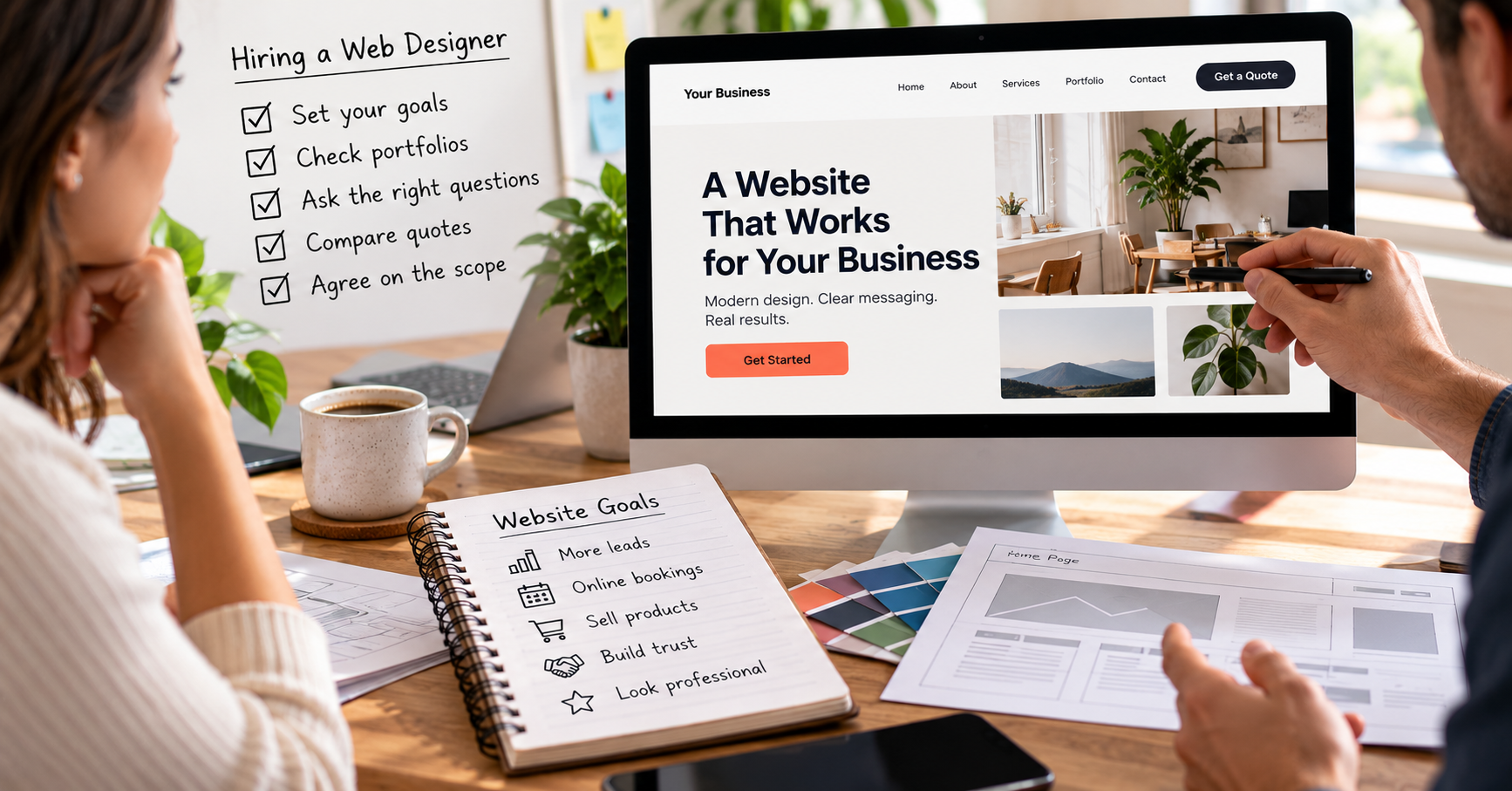
To hire a web designer, write down what your site must do and what you can spend, choose between a freelancer, a studio and an agency, look at live sites they have built, ask exactly what the quote includes, and agree the scope in writing before you pay a deposit. The best designer for you is the one who has built something like your site and can explain the price line by line.
Key takeaways
- Start with your goal and your budget, not with a designer. A clear brief gets you more accurate quotes.
- Match the hire to the job. A freelancer often fits a smaller, standard site. A studio or agency fits a larger or more custom one.
- Judge live websites, not screenshots, and ask to speak with a past client.
- Published prices vary a lot and come from companies that sell web design. Use them to check a quote, not as a price list.
- Ask what is in the quote: pages, revisions, content, platform, and what happens after launch.
- Pay in stages tied to milestones, and make sure the website account is in your name.
- Having your logo, photos and text ready before you start saves time for both sides.
Start with a one-page brief
Before you contact anyone, write down what you need. A web designer can only quote accurately for a job they understand, and a brief also helps you compare quotes fairly.
- The goal. Do you want phone calls, form requests, bookings or online sales?
- The pages. A one-page site, a handful of pages or a store with products?
- Your budget range. Southtown Web Design points out that the most expensive designer is not automatically the best fit.
- What you already have. Logo, brand colors, photos, videos and written text.
- Two or three websites you like. They show your taste faster than a description.
- A deadline, if you have a real one. Tight deadlines can hurt quality, and Dribbble reports that rush work can add 25 to 50 percent.
The brief can be short. Even half a page helps you get better quotes.
Freelancer, studio or agency: who should build your site?
The choice depends on how custom the site is and how much support you want. Dribbble and Southtown Web Design both describe the same trade-off, and both sell design services themselves.
| Option | Usually a good fit when | Watch for |
|---|---|---|
| Freelancer | You have a smaller budget, a standard site and a clear brief | Limited capacity and uneven skill levels. Ask who covers for them if they are unavailable |
| Small studio | You want design and setup handled together by a small team | Ask who actually does the work and whether the portfolio shows their own sites |
| Agency | The site is large or complex and needs several specialists | Higher cost and less direct contact. Ask who you will talk to day to day |
| In-house hire | You need constant updates over the long term | A high fixed cost, which rarely suits a small business starting out |
A useful test is to ask each candidate to describe a site like yours that they have already built. If they cannot, the size of the company will not make up for it.
The platform matters too. Your site might run on Wix, WordPress, Shopify or something else. A good designer can explain why they recommend one for your goals. If you are building an online store specifically, see our guide on how to hire a Shopify designer.
Where to find a web designer
Each channel gives you a different kind of evidence, so use more than one.
- Referrals. Ask other business owners who built their site. A referral comes with a real project you can look at.
- Freelance marketplaces such as Fiverr and Upwork. You can compare many profiles, prices and reviews quickly. Quality varies, so shortlist on live sites, not on ratings alone.
- Search and local listings. Studios and agencies show case studies and packages on their own sites, which they curate, so ask for a reference.
- Social media and design communities. Portfolios here show style, but only a live site shows how the work performs on a phone.
- Sites you admire. Many sites credit their designer in the footer, or you can simply ask the owner.
Aim for three candidates. Send all three the same brief and compare their answers side by side.
What to ask before you hire
Good answers are specific. Vague answers are information too.
- Can you show me two or three live sites you built that are similar to mine? Open them on your phone.
- Can I speak with a past client? References and testimonials are standard to ask for.
- What is your process from first call to launch?
- What exactly is in the quote? Pages, revisions, mobile testing, content, launch support.
- What do you need from me, and by when? Logo, photos, text, approvals.
- How do revisions work? Ask how many rounds are included and what counts as a new request.
- Which platform will you use, and why? And will the account be in my name?
- What happens after launch? Who fixes bugs and small mistakes, and what does a later change cost?
- How quickly do you reply, and who will I talk to?
Fiverr's guide suggests a cheap way to test a designer: start with a small project and see how they handle feedback before you commit to a larger one. Put the answers in writing. A short scope document with deliverables, a timeline, the revision policy and the payment schedule prevents most disagreements.
What it costs to hire a web designer
Prices vary because the work varies. The companies below sell web design or hire designers, so read these as market ranges, not quotes.
| Type of hire | Published range | Source |
|---|---|---|
| Freelancer, starter site | $500 to $1,500 | Dribbble |
| Freelancer, small business site | $1,500 to $5,000 | Dribbble |
| Freelancer, advanced site or online store | $5,000 to $15,000+ | Dribbble |
| Freelancer, simple landing page up to an advanced site | about $500 to $5,000+ | Fiverr |
| Freelancer, hourly | about $28 for a newer designer, about $75 for an experienced one | Fiverr |
| Agency, fixed project | from $10,000 | Dribbble |
Both sources agree on the pattern: agencies cost more than freelancers, and the final price follows the size and complexity of the site. For a deeper breakdown that includes hosting and maintenance, see our guide to small business website cost.
What changes the price
- Design complexity, such as custom features and graphics.
- The platform and tools, because some builders are free and custom code costs more.
- How much content you supply, and whether the designer has to write or source it.
- Updates and maintenance after launch, which are an added cost.
- A rushed timeline, which Dribbble says can add 25 to 50 percent.
When you compare quotes, compare the work, not only the total. Southtown Web Design suggests weighing the value offered, not just the price. Ask each designer to list what is included line by line.
Red flags when hiring a web designer
None of these proves a designer is bad, but each is a reason to ask more questions before you pay.
- No portfolio, or only screenshots. A mockup shows intent. A live site shows the result.
- No client references or testimonials.
- A quote with no scope. If you cannot tell what is included, you cannot compare it with another quote.
- Unclear costs. Ask for a written list of what you will pay for now and later.
- A very low price with big promises. Check what is left out, such as revisions, mobile testing or launch support.
- An unrealistic timeline.
- Unprofessional or slow communication before you hire. It rarely improves once the work starts.
- Full payment upfront. Staged payments tied to milestones protect both sides.
- No access for you. You should own the domain and the website account and receive the design files.
If two or three of these show up with one candidate, move on to the next on your list.
What to have ready before you hire
A designer can only move as fast as the material you send.
- Your logo and brand colors, or a note that you need them created.
- Photos and any videos you want on the site.
- The text for each page, or an outline of what you want to say.
- Two or three websites whose style you like.
- Your goal for the site, in one sentence.
- Logins for your domain, if you already have one.
How Barry's Software handles a website project
Barry's Software builds websites on Wix and WordPress, and online stores on Shopify. A standard package is built around the client supplying the brand and content: logo, branding and colors, pictures, videos and text. It covers:
- A custom landing page or homepage, with product pages and a collections page for stores.
- Up to 5 design revisions.
- Example sites you like, used as a style reference.
- A turnaround of 1 to 3 weeks, for up to three pages.
- For online stores, up to 30 products with the descriptions, images and pricing you provide.
- Help fixing bugs and small mistakes after launch.
Installing and setting up apps is not part of the package and is quoted separately. For a number on your own site, request a quote and tell us the pages and features you need.
Request a quoteFrequently asked questions about hiring a web designer
How much does it cost to hire a web designer?
Published ranges for a freelancer run from about $500 for a simple site, to about $1,500 to $5,000 for a small business site, and $5,000 to $15,000 or more for an advanced site or store. Agency projects are listed from about $10,000. These companies sell web design themselves, so treat the numbers as a guide and compare written quotes.
Should I hire a freelancer or an agency?
A freelancer often fits a smaller budget and a standard site. An agency fits a larger or more complex site that needs several specialists. Whoever you choose, ask for live examples similar to your site.
How do I find a good web designer?
Start with referrals and sites you admire, then compare a few candidates from marketplaces or studio websites. Shortlist on live work and references, not only on ratings.
What should I ask a web designer before hiring them?
Ask for live examples, a past client to speak with, what the quote includes, how many revisions are covered, which platform they will use and why, and what support you get after launch.
What does a web designer need from me?
Usually your logo and brand colors, photos, text for each page, a few example sites you like and a clear goal for the site. Having these ready helps the project move faster.
Should I pay a web designer upfront?
Staged payments tied to milestones are common and protect both sides. Be cautious about paying the full amount before any work is delivered.
How long does it take to build a website?
It depends on the number of pages and how quickly you send content and approvals. Ask each designer for a timeline and what could change it.