
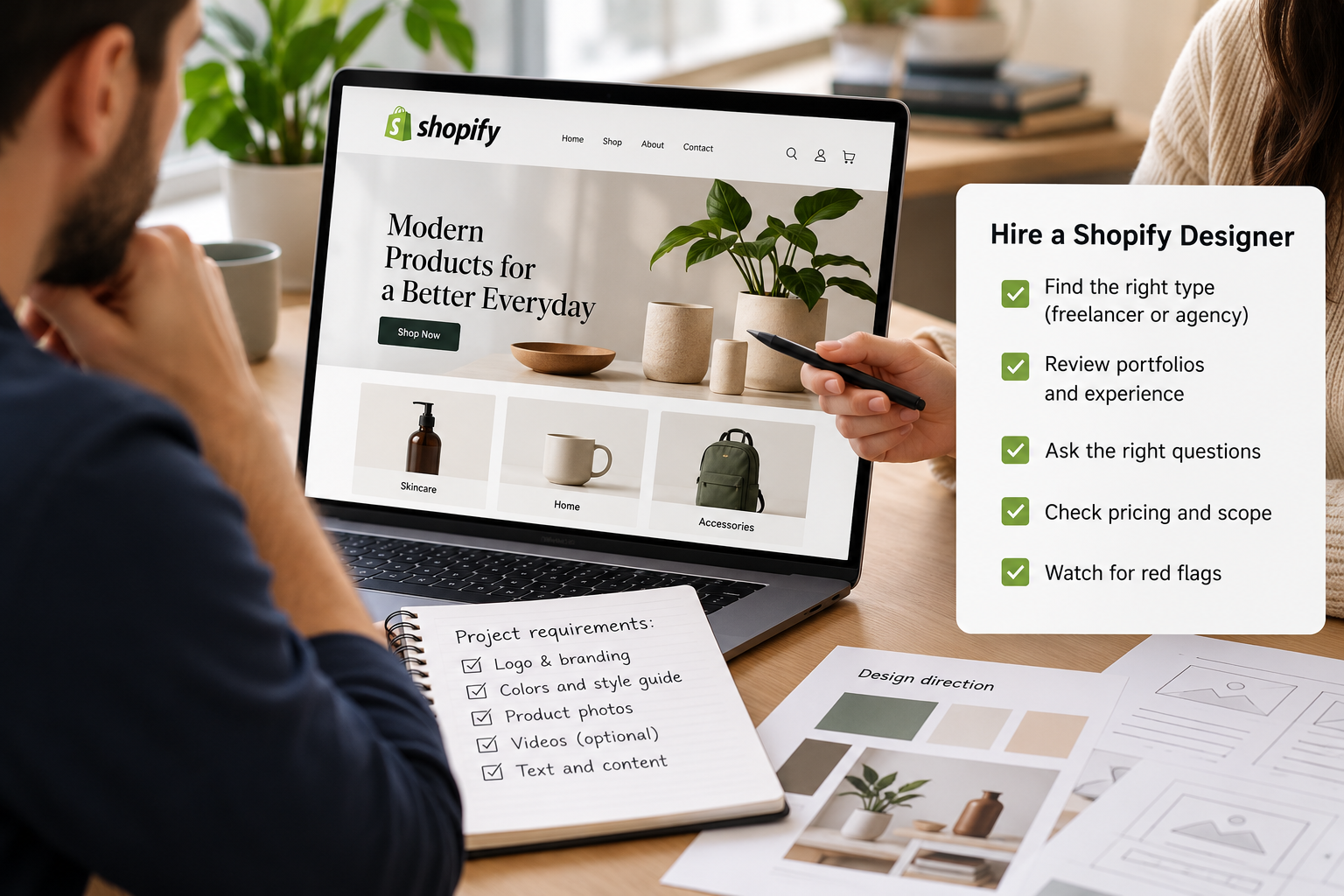
To hire a Shopify designer, decide whether your store needs a freelancer, a studio or an agency, look at live stores they have built, ask exactly what the quote includes, and pay in stages against a written scope. Freelancers usually fit smaller stores and agencies fit complex builds, but the quality of the work matters more than the size of the team.
Key takeaways
- Match the hire to the job. A simple store setup rarely needs an agency, while custom features such as subscriptions or heavy integrations may.
- Judge live Shopify stores, not screenshots. Open them on your phone and check how fast they load.
- Shopify's partner directory helps you browse and filter, but Shopify says partners work independently, so you still check the work yourself.
- Published prices vary a lot and mostly come from companies that sell Shopify services. Use them to sanity check a quote, not as a fixed price list.
- Get the scope in writing: pages, products, revisions, apps, who supplies the content, and what happens after launch.
- Projects move faster when your logo, brand colors, photos and product text are ready before the designer starts.
Freelancer, studio or agency: who should you hire?
The right choice depends on how much of the store is standard and how much is custom. A store built on a theme, with your products, a few pages and a clean layout is a small job. A store that needs subscriptions, custom logic or several connected systems is a bigger one.
| Option | Usually a good fit when | Watch for |
|---|---|---|
| Freelancer | You have a smaller budget, a clear brief and a standard store, or you only need theme edits and bug fixes | One person means one calendar. Ask who covers for them if they get sick or busy |
| Small studio | You want design and setup handled together, with fewer handoffs than an agency | Ask who actually does the work and whether the portfolio shows their own stores |
| Agency | The store is large or complex and you need several specialists | Higher cost and more layers. Ask who you will talk to day to day |
A useful test is to ask each candidate to describe a store like yours that they have already built. If they cannot, the size of the company will not make up for it.
Whether someone works only on Shopify or on several platforms, ask how many of their live projects are on Shopify. Experience with the platform matters more than the job title.
Where to find a Shopify designer
There is no single best place. Each channel gives you a different kind of evidence.
- Shopify's partner directory. You can browse by category and location and filter by price, services and partner tier. Shopify says partners "work independently" and that you set your own terms with them. The directory page does not describe how partners are vetted, so treat a listing as a starting point and check reviews and work samples yourself.
- Freelance marketplaces such as Upwork and Fiverr. You can compare many profiles quickly and read reviews from past buyers. Quality varies widely, so shortlist on live stores, not on the profile photo or the star rating.
- Referrals from other store owners. Ask in ecommerce communities or ask owners of stores you admire who built them. A referral comes with a real project you can look at.
- Portfolio sites and social profiles. Dribbble, Behance and personal sites show design taste, but only a live store shows how the work performs on a phone.
- Studios and agencies directly. Their case studies are curated by them, so ask to speak with a past client.
Whichever channel you use, aim for three candidates. Ask all three the same questions and compare the answers side by side.
What to ask before you hire
Good answers are specific. Vague answers are information too.
- Can you show me two or three live Shopify stores you built? Open them on your phone. Check load speed, the cart and the checkout path.
- What is your process from first call to launch? A designer with a real process can describe the steps without hesitation.
- What exactly is in the quote? Ask about the number of pages, how many products they will load, how many design revisions are included, mobile testing and launch support.
- What do you need from me, and by when? Logo, brand colors, photos, videos, product descriptions and prices are the usual list. Ask what happens to the schedule if they arrive late.
- Are apps included? Installing and configuring apps is often priced separately from the design. Ask for it as a separate line.
- How do revisions work? Ask how many rounds are included and what counts as a new request instead of a revision.
- Who owns the store and the files at the end? You should hold the admin login and the design files.
- What happens after launch? Ask whether small fixes are covered, for how long, and what a later change costs.
- Who will I talk to, and how quickly do you reply? Agree on a channel and a reasonable response window.
Put the answers in writing. A short scope document that lists deliverables, a timeline, the revision policy and the payment schedule prevents most disagreements later.
What it costs to hire a Shopify designer
Published prices differ a lot because the work differs a lot. Two companies that sell Shopify services give different numbers for the same kind of job, which is why a range is a better guide than a single figure.
| Job | Freelancer (published range) | Agency (published range) |
|---|---|---|
| Basic store setup | $300 to $800 (ecomm.design); $1,000 to $2,500 (Storetasker) | $5,000 to $10,000 (Storetasker) |
| Custom branded design | $1,000 to $2,500+ (ecomm.design) | Not listed separately |
| Mid-tier build with custom theme and integrations | $3,000 to $6,000 (Storetasker) | $15,000 to $35,000 (Storetasker) |
| Complex build (subscriptions, custom logic, headless) | $7,500 to $15,000 (Storetasker) | $50,000+ (Storetasker) |
Both sources sell Shopify services themselves, so treat these as market ranges, not quotes. Storetasker's article was published April 9, 2026 and ecomm.design's July 16, 2025. Prices change, so check them again before you budget.
What changes the price
- The number of pages and products to build.
- How much is custom design versus a theme with your branding.
- Apps and integrations, which are often priced on top of the design.
- Whether you supply the logo, photos and text, or need them created.
- How many revision rounds are included.
- Support after launch.
One of the sources suggests keeping 15 to 20 percent of the budget aside for changes you did not plan. That is a reasonable habit whichever range you are in.
For your own quote, ask each designer to list what is included line by line. Two quotes with the same total can cover very different work.
Red flags when hiring a Shopify designer
None of these proves a designer is bad, but each one is a reason to ask more questions before you pay.
- Only screenshots, no live stores. A mockup shows intent. A live store shows the result.
- A quote with no scope. If you cannot tell what is included, you cannot compare it to another quote.
- A very low price with big promises. Check what is left out: revisions, mobile testing, product upload or launch support.
- An unrealistic timeline. Ask how the schedule changes if your content arrives late.
- No questions about your business. A designer who does not ask about your products, customers and goals is building a template, not your store.
- Full payment upfront. Staged payments tied to milestones protect both sides.
- No access for you. You should own the store admin and receive the design files.
- Hard to reach before you hire. Slow replies at the sales stage rarely improve once the work starts.
If two or three of these show up with one candidate, move to the next one on your list.
What to have ready before you hire
A designer can only move as fast as the material you send. Gather these first and your quotes will be more accurate too.
- Your logo and brand colors, or a note that you need them created.
- Product photos and any videos you want on the store.
- Product titles, descriptions and prices, in a spreadsheet if you can.
- The text for your homepage and other pages.
- Two or three websites whose style you like, so the designer can see your taste.
- A list of any apps you already use or plan to use.
How Barry's Software handles a Shopify design project
Shopify is the main focus at Barry's Software. A standard package is built around the client supplying the brand and content, and it covers:
- A custom landing page or homepage, product pages and a collections page.
- Up to 30 products, added with the descriptions, images and pricing you provide.
- Up to 5 design revisions.
- Example sites you like, used as a style reference.
- A turnaround of 1 to 3 weeks, for up to three pages.
- Help fixing bugs and small mistakes after launch.
Installing and setting up apps is not part of the package and is quoted separately. If you want to know what your store would cost, request a quote and list your products, pages and apps so the quote is specific.
Request a quoteFrequently asked questions about hiring a Shopify designer
How much does it cost to hire a Shopify designer?
Published ranges for a basic store setup run from a few hundred dollars to about $2,500 for a freelancer and about $5,000 to $10,000 for an agency, according to two Shopify service companies. Custom design, apps and complex features raise the price. Ask for a line-by-line quote.
Should I hire a freelancer or an agency for my Shopify store?
A freelancer usually fits a smaller budget and a standard store. An agency fits a large or complex build that needs several specialists. Whichever you choose, review live stores they built and ask exactly what the quote includes.
Is the Shopify partner directory a guarantee of quality?
No. Shopify's directory lets you browse and filter partners and says they work independently. The page does not describe a vetting process, so check reviews, work samples and live stores yourself.
What should I ask a Shopify designer before hiring?
Ask to see live stores they built, how their process works, what the quote includes, how many revisions are covered, whether apps are included, who owns the store at the end, and what support you get after launch.
What does a Shopify designer need from me?
Usually your logo and brand colors, product photos, product descriptions and prices, text for your pages and a few example sites whose style you like. Having these ready helps the project move faster.
How long does it take to build a Shopify store?
It depends on the number of pages and products and on how quickly you send content. Ask any designer for a timeline and what could change it. Late content is a common reason schedules slip.
Do I pay all at once or in stages?
Staged payments tied to milestones are common and protect both sides. Be cautious about paying the full amount before any work is delivered.